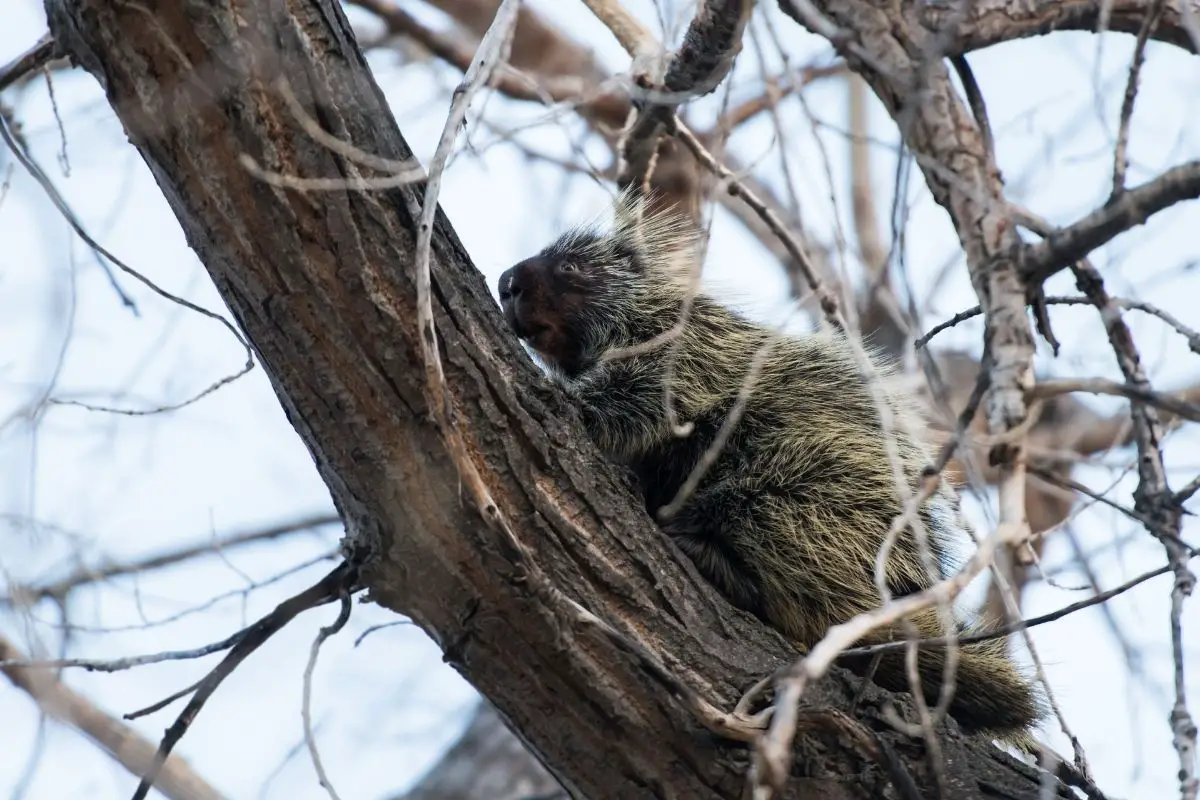
Depending on where you stand, there’s something about nature that’s cute, stubborn, destructive, or dangerous. When it comes to porcupines, they embody nature. Their adorable faces and non-aggressive demeanor are welcoming, but the 30,000 quills on a porcupine’s back say, “not too close.”
Quills are the thorn-like structures on a porcupine’s body. Sometimes, they’re referred to as spines. With a porcupine, it’s a matter of ‘just look and don’t touch.’
Trust me, I learned this the hard way once I developed an interest in these animals! On the positive side, I also discovered that, contrary to popular belief, porcupines don’t shoot their quills. What happens is they get stuck and dislodge once they come into contact with human or animal flesh.
This is made possible by microscopic fish-hook-like barbs at the tip of each quill. But there is much more to this cute, ‘look but don’t touch,’ mammal. Let’s explore.
Amazing Facts About Porcupines
Porcupines are the world’s third-largest rodent after the capybara and the beaver. The quill-covered animals use their quills to defend against predators like lions, leopards, and humans. Biologically, porcupines are in the order Rodentia, but they subdivide into the Hystricidae and Erethizontidae families.
In layman’s terms, these two families are understood as Old World porcupines and New World porcupines, respectively. Old World porcupines are found in Asia, Italy, and Africa, while the New World porcupines are in North America and northern South America. Furthermore, porcupines are nocturnal, but the New World porcupines are not strictly nocturnal.
At times they come out during the day. They can also inhabit the trees and are generally smaller in size.
Different Types of Porcupines That Exist Today
There are many types of porcupines, many being considered new world and the others old world porcupines. Some of the new world porcupines are from a declassification of defunct taxonomic groups. Follow along as we explore all the types including their histories, habitats, diets, size, and much more..
Old World Porcupines
Old World porcupines are terrestrial rodents. They are larger and are strictly nocturnal. They primarily live in Africa, Europe, and Asia.

No comments:
Post a Comment